|
ENDORSEMENTS
"What a windfall of history and wisdom from the doyenne of the study of women and politics! Freeman's essays offer new information and rich insights into more than a century of history of women in party and electoral politics, policy formation, and gendered voting patterns." — Susan M. Hartmann, The Ohio State University
"Jo Freeman is the best of all possible political scientists: one committed to activism and truth at the same time. Anyone who reads We Will Be Heard is likely to get hooked on the drama of the Equal Rights Amendment in Congress, or the mystery of the missing-from-history fifty women who ran for President -- and become as fascinated with politics as a true democracy requires."— Gloria Steinem
A compelling and authoritative analysis of women in the past century of American politics. This classic study is essential reading for anyone interested in the history of how women shaped American politics and how American politics shaped women's public activism from the 1890s to the present. — Kathryn Kish Sklar, SUNY Binghamton
REVIEWS
WE WILL BE HEARD
Kristie Miller
NewsTribune of LaSalle, IL
4/4/08
Hillary Clinton’s historic run for president of the United States may look like an individual marathon.
But it is a relay race.
If Hillary makes it across the finish line, it will be because she is carrying the final baton in a long line of women who have run for elected office.
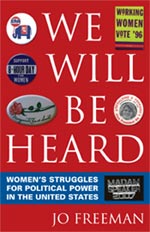
These forerunners are chronicled in a new book, We Will Be Heard: Women’s Struggles for Political Power in the United States, by Jo Freeman, a noted political scientist.
“Long before women could vote they ran for public office,” Freeman writes. In the 19th century, two women ran for president: Victoria Woodhull and Belva Ann Lockwood.
It would be 80 years before another woman ran: Sen. Margaret Chase Smith, in 1964. The election process changed in the 20th century; it became more difficult for candidates to get on the ballot.
When Smith announced her intention to run, she said one of her reasons was “to break the barrier against women being seriously considered for the presidency of the United States.” She won 25% of the vote in the Illinois Republican primary that year.
Smith did not expect to win; most of the men running that year were not expected to win, either.
Freeman notes that many female candidates, like many male candidates, run simply to have a chance to talk about issues that matter to them.
More than fifty more women have run since 1964.
The most successful woman presidential candidate until now was U. S. Representative Shirley Chisholm, an African American congresswoman from Brooklyn, New York, who ran in 1972. Over 400,000 people voted for her in fourteen primaries.
Freeman’s chapter on the fifty female presidential candidates is one of fourteen stimulating essays on the hidden history of women in politics.
Her “search for political women” begins with Judith Ellen Foster, hired by the Republican Party in 1880 to attract the new and potential female voters.
One of my own favorites is Sophinisba Breckinridge, Freeman’s “model of a political woman.” Breckinridge, who moved to Chicago in 1890, earned two PhD’s and a law degree. She then taught women’s studies at the prestigious University of Chicago. Her groundbreaking 1933 survey on women’s political, social and economic progress foreshadowed works like Freeman’s.
Freeman discusses policy as well as personalities: she explores the “gender gap” in earlier elections (women voted in significantly greater numbers for Hoover and Eisenhower); the real story of how Title VII, banning discrimination based on sex, was included in the Civil Rights Act of 1964; and the vexed history of the Equal Rights Amendment.
Freeman discussed her book last week at the Woodrow Wilson Center in Washington DC.
Inevitably, she was asked about Hillary Clinton’s prospects.
Freeman noted that Hillary has three hurdles to overcome, in addition to being a woman.
One, she is a wife. Traditionally, widows have been more successful than wives in running for office. Witty Alice Roosevelt Longworth observed about the early women in Congress that they had “used their husbands’ coffins as springboards.”
As a wife, Hillary “will have to deal with Bill’s baggage,” Freeman warned.
A second drawback is that Hillary is from New York, where politicians have to run left of mainstream America to get elected. While she might win the primary, Freeman said, she would likely be too liberal for the rest of the country.
Finally, said Freeman, “there is still latent prejudice against women exercising executive power.” Hillary Clinton would be in a stronger position if she had been governor of a big state, instead of a senator.
Still, Freeman is hopeful. “This is the election I have been waiting for all my life,” she said.
Amazon.com Customer Review by M. Saint-Germain
January 14, 2009
From Contemporary Sociology September 2009
This is a history of women's political struggles and participation in the United States, told by political scientist Jo Freeman through fifteen case studies. The cases studied occur from the late nineteenth century to very recently, concluding with Nancy Pelosi's installment as Speaker of the House in 2007. While Pelosi is a familiar figure, the unfamiliarity of many of the names in this volume demonstrates its timeliness, given Hillary Clinton's unprecedented recent campaign. One chapter details the much less successful presidential campaigns of a number of other women, going back as far as the late 1800s and picking up in 1964 with the first candidate for a major party's nomination -- Margaret Chase Smith.
While long-past events, such as those following the passage of the Nineteenth Amendment, are included, much of the volume focuses on women's political struggles during the last fifty years. Two chapters are dedicated to the story of the push for passage of the Equal Rights Amendment and another focuses on the complex relationship of feminism with the major political parties. Also included are brief chapters focusing on the campaigns and careers of individual women, including Florida Congresswoman Ruth Bryan Owen and Maine Republican Marion Martin.
The format of the volume, as a collection of case studies rather than a linear history, does not diminish its usefulness as an overview of the history of women in American politics, particularly in the last half-century. Sociologists who are too young to have personal memories of the 1960s and 70s will find this engaging book particularly instructive.
Published in Politics and Gender Vol. 6, No. 1, March 2010, pp. 162-164.
We Will Be Heard: Women's Struggles for Political Power in the United States.
By Jo Freeman.
Lanham, MD: Rowman & Littlefield. 2008. 276 pp. $80.00; cloth, $29.95 paper.
Marianne Githens
Goucher College
The emergence and development of the field of women and politics in political science almost entirely overlaps the scholarly career of Jo Freeman. It also coincides with her work as an activist, from the time of her undergraduate studies to the present. For more than 40 years she has participated in the most important social movements of the later half of the Twentieth Century: civil liberties, the free speech movement, Civil Rights, and the women's movement. Her scholarly works have consistently reflected both of these pursuits by blending meticulous scholarship with an understanding of events derived from personal experience. Her skill in combining theoretical analysis and activism is perhaps best illustrated in an article, "The Tyranny of Structurelessness" which first appeared in 1972. That piece gained instant attention among a group of budding young feminist scholars and is widely acknowledged as a perceptive critique of the early Women's Liberation Movement. It was followed shortly thereafter by The Politics of Women's Liberation, a book that clearly established her as an outstanding feminist scholar, and which even today is acknowledged as classic in the field of women and politics.
Over the course of the following years, Freeman has continued to publish prolifically and to influence succeeding generations of scholars. Indeed, her textbook for women's studies (Women: A Feminist Perspective) was considered an important addition to the available material in the field and used in a great many introductory courses in colleges and universities throughout the country. Her latest book, We Will Be Heard, represents her most recent contribution to the fields of political science and women's studies. Written over a number of years, it provides some Iittle known information on women's political participation in Amcrican politics during the past two hundred years and discusses the circumstances surrounding efforts to pass a number of public policies that would affect the lives of women. Some of the chapters, such as the one dealing with the Equal Rights Amendment ("All the Way for the ERA: Winning and Losing in Virginia"), were previously published or given as lectures at professional meetings; others are original for the book.
Freeman first attended a national party convention in 1964 and has attended every Republican and Democratic convention since 1976. As one might expect, then, the chapters dealing with women's involvement in political parties are both insightful and nuanced. The material focusing on women's early activities in politics and their relationships with political parties, particularly the problems that they faced in terms of the reactions of political parties to their inclusion, will be of particular interest to younger college and university students are often unaware of the long struggle women have waged to be heard and to participate ill the political process. Of special importance is Freeman's discussion of women's association with the Republican Party.
Today we are often tempted to associate Women active in politics exclusively with the Democratic Party and to view it as having always been more "woman friendly." Freeman clearly points out the fallacy of this perception and paints a compelling picture of the importance of Progressive Republicanism at the turn of the twentieth century for women’s political activism. Indeed, as she comments, the transformation of the Republican and Democratic Parties in the last decades of the twentieth century in terms of their feminist/antifeminist stances was neither planned nor predictable. While the standard explanations are offered to explain the changes in each party regarding women as stemming from its position on social issues such as abortion,
the growing importance of evangelical religion, the need to appeal to a somewhat different voter, and so on, it would have been useful if Freeman had addressed in greater detail the demise of Republican women's organizations in the face of the increasing power of the party's movement to the right.
Earlier chapters discuss the organizational skills of Republican women and the relative ineptness of Democratic women. The history of women's organizational structures in both parties raises the question: What promoted such a precipitous decline in the role of Republican women in their party and an increase in that of Democratic women? The question becomes more intriguing in light of the selection of a woman as the Republican vice presidential candidate in 2008. With the number of highly qualified Republican women in Congress and especially in the Senate, one wonders what role Republican women played in discussions of the selection of a recently elected and less experienced governor, rather than a woman with a national reputation and a long history of public service. Knowing Freeman as I do, 1 am sure that she is already well at work on this question and look forward to reading her analysis. Nevertheless, some further discussion of women's role in the Republican and Democratic parties would have been helpful.
The chapters dealing with Title VII, equal rights, and comparable worth provide some fascinating insights into the controversies generated by each of these bills. Here again, material blending careful research, personal experience, and knowledge shed important light on efforts to enact policies that sought to improve the lives and chances of American women and to overcome the obstacles confronting those seeking to make these changes. Many undergraduate and graduate students will find this material useful for understanding women's attempts to "break the glass ceiling."
The task of synthesizing material written at an earlier date with new work poses a problem for all authors. In a few instances, it distracts from the narrative flow of We Will Be Heard. Nevertheless, the book is essential reading for anyone interested in the field of women and politics.
|